

Anyone who has spent time managing a large distribution facility understands the particular frustration of an inventory count that refuses to reconcile. Shipments logged correctly at dispatch arrive with unexplained discrepancies. Stock that the system shows as available cannot be physically located on the floor. Cycle counts consume several days of labor and still produce errors that surface weeks down the line.
These situations are rarely the result of careless staff or poor management. More often, they reflect a structural limitation that manual inventory processes have never been well-equipped to overcome at scale. Warehouse automation Drone has become the most direct response to that limitation — and the facilities that have committed to it are finding that the gap between system records and physical reality narrows considerably.
The Real Cost of Inaccurate Inventory Data
Inventory errors seldom announce themselves. A miscounted pallet in an overflow bay, a misscanned unit during a busy shift, a stock movement recorded against the wrong location — individually, each is minor. Collectively, they erode the reliability of the data that purchasing, fulfillment, and finance teams depend on every day.
The downstream effects tend to surface in familiar ways:
- Fulfillment mistakes reach end customers and require corrections that cost more than the original order margin
- Procurement decisions get made on stock figures that no longer reflect what is physically on hand, producing either excess inventory or unexpected shortfalls
- Inventory reconciliation exercises consume significant labor hours and still leave unresolved variances that carry forward into the next period
- Internal and external audits expose data integrity gaps that are difficult to explain and harder to remediate quickly
For warehouse managers overseeing environments with thousands of active SKUs and high daily transaction volumes, maintaining warehouse data accuracy through manual counting alone is a structural mismatch. The pace of stock movement simply outstrips what scheduled human counts can reliably track.
How Automation Is Changing the Accuracy Equation
Barcode Scanning Systems That Keep Pace With Operations
Barcode scanning systems were among the earliest technologies to make a meaningful dent in the inventory visibility problem. Assigning a scannable identifier to each unit of stock and capturing every movement through the facility created a transactional record that clipboard-based tallies were never able to produce — not at speed, and not at scale.
The generation of barcode scanning systems in use today bears little resemblance to early handheld implementations. Fixed overhead readers, conveyor-integrated scan tunnels, and mobile units that capture data at the precise point of movement have replaced the model where scanning happened at the end of a shift or during a scheduled count window. Inventory tracking workflows built on these systems update far closer to real time — which means the data warehouse staff are working from is far closer to what is actually sitting on the shelf.
In high-volume operations, that lag between physical movement and system record is where most discrepancies originate. Closing it is the first step toward reliable warehouse data accuracy.
Warehouse Automation Technologies Expanding What’s Possible
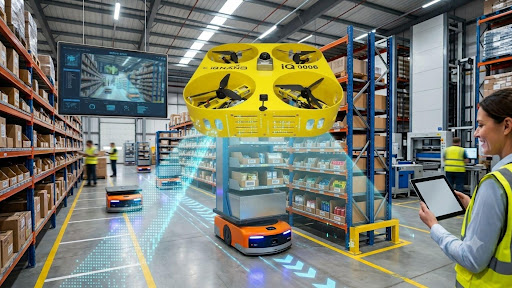
Warehouse automation has moved well beyond scanning infrastructure over the past several years. Autonomous mobile robots handle internal transport between storage and pick locations. Sortation systems route units through fulfillment sequences without manual intervention at each handoff point. Aerial platforms equipped with imaging and scanning capability are increasingly being deployed to conduct inventory cycle counting across high-rack storage environments — locations that are slow, expensive, and in some cases unsafe to count from the ground.
What these warehouse automation technologies have in common is that they produce data continuously rather than in periodic batches. Stock verification processes that previously required taking a section of the warehouse offline for a full count can instead run as an ongoing background process. Discrepancies get surfaced as they develop rather than discovered during the next scheduled audit, by which point they have often already affected operational decisions.
That shift — from periodic verification to continuous inventory cycle counting — is one of the more consequential changes that warehouse automation introduces, and its effect on warehouse data accuracy over time is significant.
Inventory Visibility Across the Full Facility Footprint
In most large warehouse environments, inventory visibility is uneven. Active pick zones near the loading dock get counted frequently. High-bay storage, overflow locations, and less-trafficked aisles receive far less regular attention — and those tend to be exactly the areas where stock discrepancies quietly accumulate between count cycles.
Warehouse automation distributes coverage more evenly across the facility. Automated scanning and imaging platforms can work through the full storage footprint on a consistent schedule, maintaining inventory visibility in areas that manual processes have historically underserved.
For inventory reconciliation purposes, this changes the character of the exercise considerably. Instead of a periodic effort to establish how much variance has built up since the last count, inventory reconciliation becomes a targeted process focused on specific flagged discrepancies — which are fewer in number and easier to trace when the underlying data has been kept current.
Facilities that have pursued inventory management innovation along these lines report that reconciliation cycles become shorter, less operationally disruptive, and more likely to reach a clean resolution.
The Connection Between Automation and Warehouse Productivity
Warehouse productivity and inventory accuracy are connected in a way that is easy to underestimate. When stock data is unreliable, operations compensate by adding verification layers — double-checking picks before dispatch, running spot counts ahead of fulfillment deadlines, holding shipments until stock can be physically confirmed. Each of those steps absorbs labor time and slows throughput.
Warehouse automation removes the conditions that make those compensating behaviors necessary. When inventory tracking workflows consistently produce accurate data, staff can act on system information with confidence rather than treating it as a starting point that needs to be verified before anything moves.
The warehouse productivity gains that follow are real — but they tend to be most durable in facilities that treat warehouse automation as a long-term operational investment rather than a short-term headcount reduction exercise. The labor efficiencies matter, but the deeper value is in the operational reliability that accurate data enables across every function that depends on it.
Where Warehouse Automation Is Heading
Stock verification processes and inventory tracking workflows are continuing to develop as the technologies supporting them mature.
Developments shaping the near-term direction:
- Continuous autonomous counting: automated platforms running inventory cycle counting on rolling schedules, making periodic full counts a progressively less necessary disruption to operations
- Integrated data environments: warehouse data accuracy flowing directly into procurement, logistics, and financial planning systems in real time, rather than being reconciled manually at month-end reporting intervals
- Predictive discrepancy detection: automated inventory processes that recognize patterns preceding stock errors and flag them before they compound into larger variances
- Expanded aerial coverage: autonomous platforms extending inventory visibility to the upper levels of high-bay facilities that ground-based systems cannot efficiently reach on a regular basis
An Operational Shift Worth Taking Seriously
Warehouse automation has reached a point where its contribution to warehouse data accuracy is well established across a range of facility types and operational scales. The facilities that have built it into their core inventory tracking workflows are not running the same reconciliation exercises, absorbing the same fulfillment error rates, or making purchasing decisions on the same unreliable data that manual-only operations contend with regularly.
For warehouse managers and logistics operators working in high-volume environments, the practical question is no longer whether warehouse automation improves inventory accuracy. It is how to implement it in a way that fits the specific operational structure, scale, and data requirements of the facility at hand.